Zoa Ace – Biography and Artistic Career
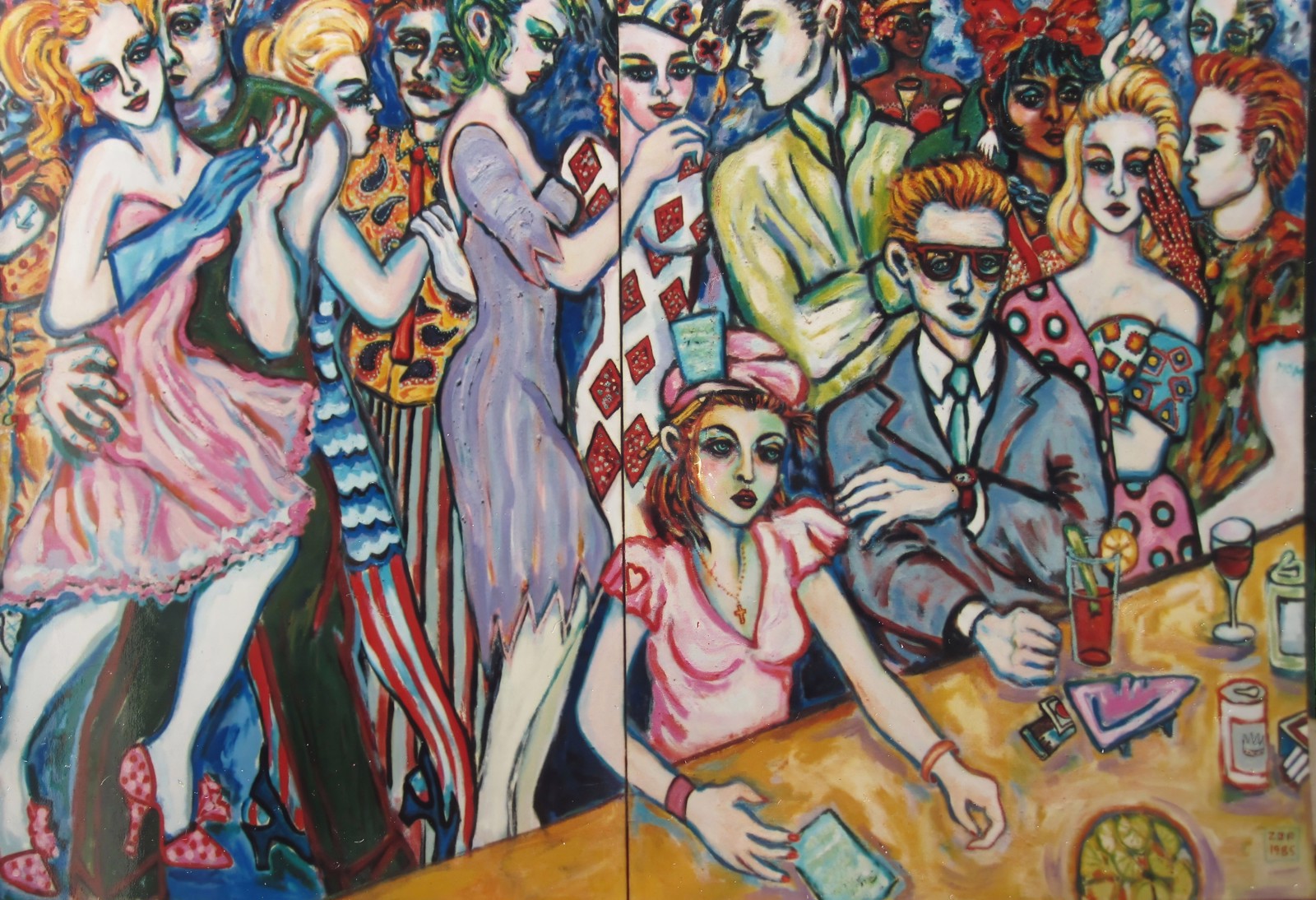
Zoa Ace – The Bartender's View | 55" x 86" | Denver Art Museum Permanent Collection
Early Life and Background
Zoa Ace is an American artist born in Rockford, Illinois, in 1951. She studied art (with a focus on art history) in college before moving to Colorado in the late 1970s with her husband, artist Louis Recchia. Settling first in Boulder and later in Berthoud, Colorado, Ace has been based in Colorado for decades (living in Berthoud for over twenty years). This Midwestern-born artist quickly became active in the Colorado art scene, launching a career that bridged her Illinois roots and her new Rocky Mountain home. Early on, Ace and her husband began showing their work simultaneously in Chicago and Denver, establishing her presence in both regional art communities from the start.
Artistic Career Milestones
1980s: Beginnings and Early Exhibitions
Ace’s professional art career took off in the 1980s, a decade during which she gained visibility through exhibitions in both Colorado and beyond. By 1981 she was featured in a solo exhibition at Denver’s Fifteenth Street Gallery, marking one of her first major showings. Throughout the mid-1980s, she participated in prominent juried and group exhibitions that signaled her emerging status. Notably, in 1986 Ace’s work was selected for Hudson Valley ‘86 (juried by renowned gallerist Holly Solomon) in New York, and for the 47th Annual Exhibition of Contemporary American Painting in Palm Beach, Florida, juried by James Demetrion of the Hirshhorn Museum. In 1988, her growing reputation earned her a spot in a showcase at the National Museum of Women in the Arts in Washington, D.C.. By the end of the decade, Ace had become a fixture in the Denver art community, showing frequently at local venues like the Boulder Center for the Visual Arts and the Arvada Center, while also maintaining ties to Midwest galleries such as Chicago’s Gilman-Gruen and Chiaroscuro galleries. This bi-regional exhibition activity underscored her unique start, effectively “pioneering the contemporary co-op art scene” in Denver alongside other rebels of the early 1980s art community.
1990s: National and International Recognition
In the 1990s, Zoa Ace expanded her reach and achieved national as well as international recognition. She gained representation in New York through Michele Mosko’s gallery, leading to her participation in high-profile art fairs. Ace’s works were shown at the SOFA (Sculpture Objects & Functional Art) expositions in Chicago (1994) and Miami (1995), where she was represented by Mosko Miller Fine Art of NYC. Around the same time, she exhibited at cutting-edge spaces like Seattle’s Mia Gallery and New York’s Tribeca Gallery, reflecting the broad geographic interest in her art. A significant milestone came in 1997 when the painting in the Denver Art Museum's permanent collection, "The Bartender's View" (oil on canvas, 55" x 86"), was selected to hang in the American Embassy in Vienna for 8 years during the Clinton Administration as part of the U.S. State Department’s Art in Embassies program. This honor, part of the U.S. State Department’s Art in Embassies program, signified international acknowledgement of her work. By the late 1990s, Ace had firmly established herself, with continuous showings at Denver’s co-op galleries (such as multiple solo exhibits at the influential ZIP 37 Gallery) as well as appearances in major cultural venues. For instance, in 1997 alone, she had a solo show at ZIP 37 and was included in a juried exhibition at the Curtis Arts & Humanities Center in Colorado. Ace’s presence in both the New York art market and the Denver scene during this era highlights the dual nature of her career: balancing national exposure with local leadership.
2000s: Established Figure in Colorado’s Art Scene
During the 2000s, Zoa Ace solidified her role as an established artist in Colorado. She was a key member of Denver’s renowned cooperative gallery ZIP 37, where she held frequent solo exhibitions (including annual solo shows in the early 2000s). Her work featured in notable Colorado museum and gallery exhibits, such as Past Revisited at the Loveland Art Museum in 2000 and the All Colorado Art Show at the Curtis Arts Center in 2005. In 2003, Ace earned a Juror’s Award at the Curtis Arts Center in Greenwood Village, CO, a testament to the impact of her work in juried competition. Around this time she also extended her involvement in the arts community beyond creating art: in 2002, for example, she served as a juror for the national art competition “Visions & Viewpoints” at the Lincoln Center in Fort Collins. Throughout the decade, Ace’s paintings were regularly on view in group shows and invitationals across Colorado and the region – from the Arvada Center’s fine art market exhibitions to appearances at Pueblo’s Sangre de Cristo Arts Center. By the end of the 2000s, Ace was widely regarded as a mainstay of Denver’s art community. The local press even suggested that it was hard to imagine Denver’s art scene without figures like Zoa Ace (and her husband Louis Recchia) who had been constants since the 1980s.
2010s to Present: Continued Productivity and Collaboration
Ace has remained highly active into the 2010s and 2020s, continuing to exhibit new work and participate in artistic collaborations. She maintained a presence at established galleries – for instance, she frequently showed at Abend Gallery in Denver (contributing annually to Abend’s juried Miniatures shows and themed exhibits). In 2012, Ace and Louis Recchia’s art was brought to life in a multimedia event – “POP DRAG”, a pop-art-inspired drag performance at Denver’s Tracks nightclub, where drag queens costumed themselves as figures from Ace’s and Recchia’s paintings. Ace also had multiple solo shows at ZIP 37 through the 2010s, up until the co-op’s closure (with solo exhibitions in 2012 and 2015). As Denver’s gallery scene evolved, she became involved with newer art spaces: in 2017 and 2018 she staged solo exhibitions at ZIP 37 and participated in shows at Pirate Contemporary Art and the emerging fooLPRoof contemporary gallery. Her work was selected for curated group exhibitions like Made in Colorado (2018 at Emmanuel Gallery, juried by Olga Viso), and in 2020 and 2021, her paintings appeared in juried and invitational shows such as the Arvada Center’s Fine Art Market and the pandemic-themed Viral Influence exhibit. A highlight of 2022 was Contemporary Storytelling, a two-person exhibition at Abend Gallery featuring Ace and Louis Recchia side by side, which underscored the enduring creative dialogue of this artist duo. Today, Zoa Ace remains an active professional artist, with gallery representation in multiple cities. She is represented by Abend Gallery in Denver and Chauvet Arts in Nashville, and continues to show new works (including oil paintings, works on paper, and collages) both online and in gallery exhibitions.
Artistic Style and Influences
Zoa Ace’s art is best known for its distinctive figurative style blended with playful surrealism and narrative whimsy. In her own words, “My work is figurative and deals primarily with human relationships. I typically use animals and theatrical settings symbolically to accentuate certain characteristics and situations. I enjoy the classical beauty of oil on canvas.”. Indeed, most of Ace’s paintings center on human figures interacting in vivid storybook scenes, often accompanied by an entourage of animals or fantastical elements that serve as metaphors. She often arranges her compositions in a theatrical or carnival-like manner – settings that might resemble a stage, a circus, or a dream-like tableau – which enhances the storytelling aspect of her work. Critics have noted that her canvases are teeming with detail: one reviewer observed that Ace’s “whimsical” scenes are full of signature motifs (sometimes called “Zoa Ace-isms”) such as vibrant calla lilies, doll-faced figures in vintage dresses, and hidden cameos by pop-culture characters like Minnie Mouse or Olive Oyl. These recurring images add layers of nostalgia and humor, inviting the viewer to hunt for playful references.
Her aesthetic balances humor and poignancy. She frequently incorporates pop culture and nostalgic imagery into her scenes, referencing everything from classic cartoon figures to famous icons of music and film. For example, some of her works have included appearances by well-known personalities (one 1980s-themed painting by Ace even depicted rock star David Bowie and model Iman amidst a lively party scene intermingled with allegorical elements of pop glamour). By blending these recognizable figures and motifs with imaginative narratives, Ace creates a connection between the viewer’s cultural memory and the fantastical world on the canvas. Her color palette is notably bold and rich – described as an “incredible color palette [that] inspires love at first sight” – contributing to the immediate visual appeal of her work.
Technically, Zoa Ace is acclaimed for her skill in oil painting, a medium she favors for its depth and classical feel. She applies oils in a manner that celebrates traditional painting techniques (evident in her layered textures and strong compositions) even as her subject matter remains contemporary and unconventional. In addition to oils, Ace also creates watercolors and collages, expanding her practice into mixed-media territory. Some of her collage works – often assembled on wood panels – still carry her hallmark imagery, such as combining printed vintage ephemera with painted elements to achieve that same theatrical, storybook quality. Across all mediums, Ace’s attention to narrative detail and her imaginative symbolism remain constant.
One of Ace’s acknowledged artistic influences is the German Expressionist painter Max Beckmann (1884–1950). Beckmann was known for his intense figurative scenes often filled with symbolic characters, and although Ace’s palette and tone are more whimsical, one can see a connection in the way she constructs crowded, story-rich scenes. Like Beckmann, Ace fills her pictorial space with figures caught in the midst of enigmatic narratives, and she often uses bold outlines and defined forms that give her images a graphic, almost illustrative quality. Beyond Beckmann, Ace’s work aligns with traditions of narrative figuration and pop-surrealism – her use of anthropomorphic animals and dream-like juxtapositions of objects echo the spirit of Surrealism, while her inclusion of pop icons and humorous touches connect her to the Pop Art legacy. However, Ace’s style is very much her own, defined by a consistent vein of whimsy, satire, and empathy for the human condition depicted through fanciful allegories.
Exhibitions and Collections
Over the span of four decades, Zoa Ace has amassed an extensive exhibition record. She has been featured in dozens of solo and group shows across the United States. In Colorado, Ace showed almost annually at cooperative galleries (notably ZIP 37 Gallery, where she was a member and had regular solo exhibitions throughout the 1990s and 2000s). She was also invited into many juried and invitational exhibits at cultural institutions in the region – such as the Arvada Center’s yearly Fine Art Market, the Dairy Arts Center in Boulder, and the Sangre de Cristo Arts Center in Pueblo. Ace’s national exhibition highlights include her participation in the National Museum of Women in the Arts annual exhibit in 1988, and representation in New York City through Michele Mosko Fine Art, which showcased her work both in its NYC gallery and at major art fairs. Internationally, one of her career highlights was having her artwork displayed at the U.S. Embassy in Vienna, Austria in 1997, signifying her inclusion in the prestigious Art in Embassies program.
Selected Major Exhibitions:
- National Museum of Women in the Arts (Washington, D.C.) – Included in a national women’s art exhibition (1988).
- SOFA Art Fairs (Chicago 1994; Miami 1995) – Exhibited sculptural paintings with Michele Mosko Fine Art.
- U.S. Embassy in Vienna – Art in Embassies exhibition of Ace’s painting (1997).
- Multiple solo exhibitions at Denver’s ZIP 37 Gallery and Abend Gallery.
- Loveland Museum – Past Revisited group exhibition (2000).
- Curtis Arts Center – All Colorado Art show (2005) and Juror's Award (2003).
- Lincoln Center – National juried show “Visions & Viewpoints” (2012; Ace served as a juror).
- Pirate Contemporary Art – Featured in co-op invitational shows (e.g., 2017 “Outsider” show).
- Arvada Center – Multiple exhibitions including the Fine Art Market (recurring, 2010s) and the juried thematic show Viral Influence (2021).
In addition to her exhibition history, Zoa Ace’s work has been acquired into several important collections. Her paintings are held in the permanent public collections of notable institutions, including the Denver Art Museum and the Kirkland Museum of Fine & Decorative Art (formerly Vance Kirkland Museum, Denver). Healthcare institutions have also collected her art, such as Children’s Hospital Colorado in Denver and Kaiser Permanente’s corporate art collection. Ace’s art can be seen in other public settings as well – for instance, the El Pomar Foundation (Broadmoor Hotel) in Colorado Springs owns her work, and a large-scale piece of hers adorns the Maven Hotel in downtown Denver. Moreover, her work has reached private collections across the United States and Europe.
Critical Reception and Media Coverage
Throughout her career, Zoa Ace has enjoyed positive critical reception, particularly within Colorado’s vibrant arts community. Reviews have often highlighted the imaginative joy and visual wit present in her work. In a 2014 review of her solo show at ZIP 37 Gallery, a local arts writer noted that Ace’s work “never ceases to delight viewers,” praising her “incredible color palette” and the signature “Zoa Ace-isms” in her detailed compositions. Such critiques underscore how her paintings reward close observation, with both viewers and critics remarking on the delightful interplay between nostalgia and contemporary themes.
Ace's contributions have been recognized as integral to the development of Denver’s art scene. Publications such as Denver Westword have cited her—often alongside Louis Recchia—as part of the backbone of Denver’s contemporary art world since the 1980s. Her role in shaping alternative art spaces in Denver’s Northside (with galleries like EDGE, Pirate, and ZIP 37) has been widely acknowledged, and her legacy was celebrated in a 2024 exhibit at the BRDG Project in Denver.
Media profiles also note the collaborative and lighthearted nature of her career. One memorable event, “Pop Drag Nation” (2012), featured drag performers costumed as figures from Ace’s and Recchia’s paintings, an innovative fusion of visual art and performance that garnered significant press attention.
Personal Life and Legacy
Zoa Ace’s personal life is deeply intertwined with her art. Married to fellow artist Louis Recchia, the two have collaborated and shared exhibitions over decades. Dubbed an “iconic duo in Denver’s art world,” their creative partnership has become a cornerstone of the local art legacy. Their shared sense of humor and distinctive artistic styles are evident in their joint exhibitions, and their creative synergy has made them enduring figures in Denver’s art community.
Their daughter, Mary Recchia, is also an artist who has exhibited work at ZIP 37, furthering the family’s creative tradition.
Based in Berthoud, CO, Zoa Ace continues to maintain an active studio practice and remains a mentor to younger artists in Colorado. Her longevity and sustained creativity have cemented her legacy as an artist who infuses fine art with narrative depth, humor, and a unique blend of classical and contemporary influences.
In summary, Zoa Ace’s biography is that of a dynamic figurative artist whose rich body of work—marked by vibrant colors, imaginative storytelling, and a deep engagement with cultural and artistic traditions—has left an indelible mark on both the local and national art scenes.
Sources
- Zoa Ace's Official Website (Bio and Resume)
- Morgan Adams Foundation (Artist Biography)
- 1stDibs Artist Profile
- Denver Art Matters (Review)
- Edge Gallery Profile
- Abend Gallery Artist Statements
- Denver Westword Press Coverage
- Colorado Community Media (Local Art District History)
- Pinterest (Artist Visual References)